
The Ninfa was a “registry ship”, an innovation introduced by the Spanish crown during the Anglo-Spanish war of 1739-1748 (also known as the “War of Jenkins’ Ear” or “Guerra del Asiento”), one of the different conflicts that became ingrained in the War of Austrian Succession. Traditionally, the Transatlantic route between mainland Spain and the American possessions of the Crown had been carried out by a system of fleets, in which convoys of merchant vessels were escorted by warships. Aware of their naval inferiority during the war with the British, and with the aim of preventing loses, the Spanish decided to temporarily suspend the system of fleets and allow individual ships to ply the routes between peninsular Spain, the Americas, and the Philippines. The experiment also made it possible to test how colonial markets would react to a more flexible commercial system. During the nine years of the Anglo-Spanish war, 120 registry ships sailed to New Spain and the rest of America, although more than half were lost. These ships, nevertheless, managed to keep the markets open and ensured the flow of goods and people, despite the threat posed by the British Navy and privateers.
La Ninfa had already travelled to Veracruz in the past. The documents at the Prize Papers Collection (CP5-9) offer evidence of at least a previous journey undertaken in 1741, in which English merchants had used Spanish proxy names to ship their cargo. This practice was not unusual, especially in times of peace and during the first stages of the Anglo-Spanish war. In theory, the Spanish crown controlled trade with the Americas very tightly through a strict monopoly by which only Spanish merchants could ship their goods to Americas. In practice, fraud and contraband were widespread, and trading companies from Britain, the Netherlands, France, and other countries participated in the American trade thanks to partnerships and collaborations with their Spanish counterparts. The outbreak of the War in 1739 caused serious damage to the interests of English merchants operating in Cádiz and Sevilla as well as to their Spanish partners. English traders that wanted to keep operating within the Spanish Atlantic had to find alternative ways to maintain their activity. The ownership documents of La Ninfa (SP391) can be useful for historians of business and trade interested in transnational networks and partnerships.
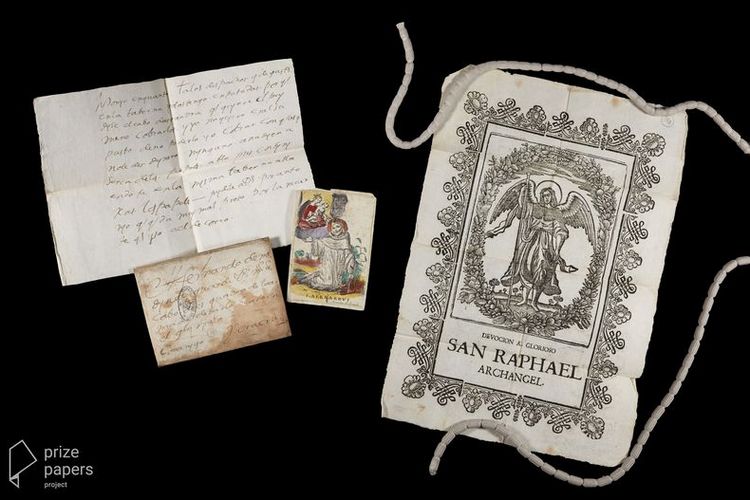
La Ninfa transported a wide collection of documents, including abundant correspondence and mail in transit from mainland Spain to the Americas. These texts offer a privileged glimpse into the daily lives, emotions, migratory networks, and commercial practices of people from all social backgrounds and from different parts of the Spanish empire. Some of the letters are related to the same people and allow us to partially disentangle complex networks of kinship and trust between both shores of the Atlantic. Many others are full of precious information about the quotidian experiences and feelings from families of humble backgrounds.
Researchers and curious individuals interested in migration, emotions, labour, gender, family life, seafaring, trade, social history, religion, and popular perceptions of politics, among other topics, will enjoy reading the sources present on La Ninfa. Some of them have already been referenced by historians: Xabier Lamikiz used some of the documents of La Ninfaand other ships on the Prize Papers collection to reconstruct the migratory patterns, interactions and relations among Basque merchants and migrants in mainland Spain and the Americas. One of the letters on La Ninfa contains a note on the margin written in Basque, a very “important piece of evidence” since the Basque language in the Eighteenth century was mostly oral. (See Xabier Lamikiz, Trade and trust in the Eighteenth Century, 121-126)
Discover HCA 32/134/7: La Ninfa in TNA Discovery
The Captors (and a monkey pet)
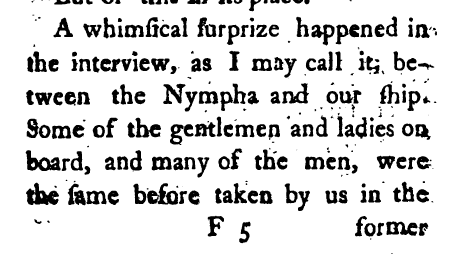
In February 1747, as it was leaving the Atlantic coasts of the Iberian Peninsula, La Ninfa was captured without offering resistance by the British privateer squadron The Royal Family, led by commodore George Walker. Walker’s squadron was very active in the final stages of the war, capturing many of the Spanish ships present in the Prize Papers Collection. However, Walker would face bankruptcy and imprisonment at the end of the war as a result of the costly chase and capture of Spanish warship El Glorioso, which produced more losses than gains. The capture of La Ninfa was one of his last profitable ventures. La Ninfa is mentioned on The Voyages and Cruises of Commodore Walker during the Spanish and French Wars, an embellished biographical account of Walker’s privateer career published in 1760 as an attempt to clear his name. There are several anecdotes and stories related to the ship on the biography, although their credibility is open to interpretation.
One of these stories features some wealthy Spanish passengers who had already been captured by Walker on the ship El Buen Consejo and were taken again on La Ninfa. When they found themselves again prisoner of Walker, they welcomed their former captors and joked about their fate, which seemed to make them meet again and again. The author of Walker’s biography claims that the commodore respected the personal belongings of their civilian captives, and that he was particularly fond of the Spanish. As a token of gratitude and appreciation for not stealing her jewels and allowing wealthy passengers to enjoy fine wines and meals, one of the passengers of El Buen Consejo, an unnamed Spanish lady, gifted Walker her lap dog, a cocker spaniel. Back on his ship, Walkers’ other pet, “a Chinese monkey of great humour and capacity,” became jealous and attacked the dog, giving it a beating that caused its death after two days. This worried Walker, who was expecting a visit by the lady in a few days and did not know how to avoid the embarrassment. He consulted the Spanish prisoners he had on board, and they advised him to give the monkey, Pug, as a present to the lady. One of the sailors thought stuffing the dead Alexander was also a good idea. The surgeon of the ship enthusiastically agreed and offered to do the task himself, and so the Spanish lady received both a monkey and a stuffed dog. According to the biography, this lady was also on board of La Ninfa so, when the ship was intercepted, the commodore and his former monkey were reunited. Unfortunately, there are no references to the monkey in the documents of La Ninfapreserved on the Prize Papers collection, so the story might have been a fabrication.
Excerpts from The Voyages and Cruises of Commodore Walker during the Spanish and French Wars, 1760, making reference to La Ninfa: