


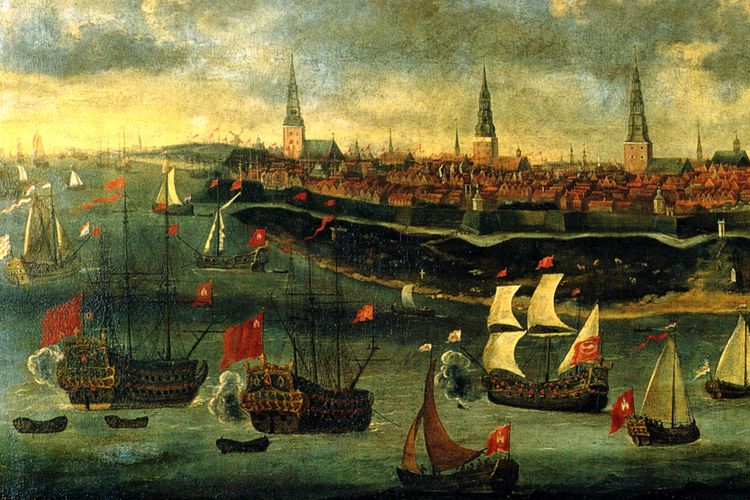

In August 1745 in the French port in Brest the Hamburg merchant Nicolaus Gottlieb Luetkens loaded his business archive onto one of his ships bound for his hometown Hamburg. Luetkens, who was born in Hamburg Billwerder but apprenticed in the Free and Imperial City of Hamburg, was the son of a priest but his uncles were also successful businessmen. One of those uncles was Joachim Kähler, co-owner of the ship Franciscus.
Nicolaus Gottlieb Luetkens (1716–1788) had spent the years 1743 to 1745 in France as a travelling merchant, visiting and doing business in the cities connected to the French Atlantic trade, and making a name for himself as a wholesale merchant. France was at war with England in 1745. So when he sent his archive – overflowing with letters from French business partners – through the English Channel to Hamburg, he preferred to play it safe and let the men hide his chest in the ‘afterhold of the ship’. But the hiding place proved inadequate. The ship to which the merchant had entrusted his business archive, the Hoffnung, was captured ‘five Leagues to the Southward of Beachy Head’. British officers found the archive and confiscated it. Luetkens never saw it again.
The Luetkens archive is today stored in the Prize Papers collection and offers us unique insights into mercantile life, trade and travel during the eighteenth century. Forgotten for centuries, it has survived in the condition it was in anno 1745. When I found it in 2012, it was still stored in Luetkens’ original ordering system, with dozens of letter bundles stuffed into the boxes, as if he had only just sent it on its way home. This archive is a real time capsule.
Due to the particular moment that it was taken from its owner – only shortly before Luetkens’ return to Hamburg and his impending marriage following two years of travel – this archive takes us right back to one of the most formative and decisive phases in the life of a merchant. It covers the stage between apprenticeship and the opening of one’s own merchant house, a period of mobility and a stage in a merchant’s career in which everything hung in the balance: the mercantile establishment phase. This case study sheds light on some of the fascinating finds from the Luetkens archive and what it can tell us about merchants, France, letters and the eighteenth century.
Discover HCA 30/232: Die Hoffnung in TNA Discovery
continued in HCA 30/233, HCA 30/234, HCA 30/235, HCA 30/236
Browse the documents in the Prize Papers Portal

When the Hoffnung left Brest for Hamburg, Luetkens was already on the finishing straight of establishing himself and settling down as a merchant. As he later wrote in a letter, the aim of his business travel to France had been to ‘to provehimself in trade’ and ‘to make friends and settle some correspondence in foreign lands.’ In other words, the business trip was intended to complete his transformation into a well-established, settled merchant in the Atlantic trade. In 1745 he had already succeeded in this undertaking with an address book full of contacts and his bags ‘full of speciethaler’ (coins). In Hamburg his future wife, Ilsabe Engelhardt, daughter of a respectable Hamburg merchant family, awaited him, together with his future business partner, Ehrenfried Engelhardt. Engelhardt was the brother of his future bride and Luetkens would later open the merchant house Luetkens & Engelhardt with his brother-in-law in the city on the Elbe. Luetkens & Engelhardt would go on to be one of the major sugar importers in Hamburg during the second half of the eighteenth century. The records in Luetkens’ travel archive from 1743 to 1745 document the path that brought him to that point in his career.
Studying this archive allows for a deeper understanding of crucial career steps taken by wholesale merchants in the establishment phase during the eighteenth century: shipping business, commission trade and high-risk trade as well as founding a merchant house and marriage. It also shows the goals and benefits of merchant travel. Luetkens’ business trip to France led him all the way along the French Atlantic coastline, and he visited all the major ports of French Atlantic trade – Bordeaux, Bayonne, Nantes, Lorient, Brest, St. Malo, Paris – before finally returning to Hamburg by land. In each of the cities, he visited a renowned merchant house, where he found a place to stay and to work for several weeks or even months. This enabled him to gain a sturdy foundation in and experience of the French Atlantic trade, to enter into lucrative enterprises with French merchants and to amass a not insignificant fortune.